I was.....
self conscious and today I am a carefree spirit.
In my first few years of high school I cared a lot about what people thought about me. I made sure to dress nicely and I barely talked in some of my class, because I was afraid of being judged by my peers. I didn't even tell my closest friends of my obsessions with Anime and Korean Pop music, because I was afraid they would judge me so much they would leave me.
However, IB brought a new side of me. I met so many new people and those people were definitely not afraid to be themselves, which inspired me to come out of the closet as a HUGE anime and kpop dork. As well as voicing my own opinions (with a great filter) and just sort of being more open to people in general. Since then i've made a plethora of great friends who have been great influences on me and kept me straight for these past two years.
AC: Okay I wish your work ethic rubbed off on me, but alas it didn't as I am procrastinating right now on this right now. However, I've managed to be influence by your perseverance. Even if you said you didn't like IB theatre, you still managed to do it everyday (very well might I add) and never completely gave up on the class and I really admire that about you. See you at UNC!! Can't wait to visit you at Granville as you help me get into shape!!
Dawson: Oh Dawson Lame. Meeting you faithfully in Ms. Fonke's chemistry class was the highlight of my life, honestly, completely non-sarcastically honestly. Really though, I know I can depend on your for anything. I learned a lot about how to talk in such away that you seem highly intelligent aka how to be respectful even if you disagree with what was said. Thanks for saving me from being rude af sometimes Dawson. I can't wait to spend the next 4 years with you at Chapel Thrill!!!
Nick: Oh Bicholas Nillman you ray of sunshine. I love your curious soul and you saved my butt in WHAP by asking all those questions, because I never read anything in that class. I learned how to have fun but be studious at the same time as well as just not caring what people thought (totally learned that from you).
Abby: ABBY I LOVE YOU SO MUCH. I CAN'T WAIT TO ROOM WITH YOU THESE NEXT FOUR YEARS. I learned so much about staying true to myself and having fun. I love your spirit and willingness to do whatever and being involved. I really can't wait to room with you! We are going to have to much fun!
Kelsey: Chapstick! You've been my best friend since middle school (even if we did meet in an unconventional way). You would think that that I wouldn't learn anymore, but I did I learned a lot from you. I'm also so happy you stayed by me to keep me in check these past few years. I love you so much and so happy you're in my life.
Amy: you're lame good bye. Okay, but really i love you to death. Even through all of your terrible jokes and puns, god they're so lame I'm actually questioning why we're friends. Okay, but really you've kept me sane and grounded this entire time. Through all my complaining and breakdowns you've been by my side and I'm very thankful for you. I really don't want to leave you, like don't go to state. C'mon you got into UNC you can come here, just come here do it.
Now I really wish I could say that I took meaningful life skills like time management out of these two years, but I really did. I did however learn great people skills and problem solving as well as being cultured and more open minded about ideas. I've learned a lot from IB that I'm sure I will use and cherish in my life from now forward. Thank you to everyone I've encountered (even if you weren't mentioned up top, if I talked about everyone I'd be here for forever) and I'm so happy to be apart of this program especially in the class of 2016. Oh and Lauren Genesky thank you for being a great English teacher. I feel like I learned so much from you (from english to just life) and I very much enjoyed having lunch with you Eric every other day. I'll be sure to come visit ((with Yumi!!))
Sunday, April 24, 2016

Sunday, April 10, 2016
What was Whitman's favorite cereal? O Captain! My Cap'n Crunch!
One initial thing that I noticed is that the notebook is very irregular and wild. The writing is everywhere and messy. It instantly reminded me of a 'fact' that I heard a while back ago about how intelligent people think fast. Therefore their handwriting is messy, because their hands can't keep up with their thoughts. That fact might be a lie, but I think it applies perfectly to Whitman. He was a creative genius. He's such a genius that I can't understand much of what he's written. Aside form that, one thing that I noticed that I thought was significant is how many times Whitman has crossed out his own writing. To me that signifies that he's always looking to improve. Also that Whitman might be a little too judgmental on himself. He never thinks his work is good enough, so he always wants to improve. That's why he consistently goes back and rewords things.
As for the images, I like them. The seem like cartoon images of Whitman, especially the second one. To me, I think it's just Whitman poking fun at himself. The sketches are something fun for his own personal entertainment. The last one definitely intrigues me, because it's so much different than the rest of them. It kind of looks like a skull with a heart shaped body doing ¯\_(ツ)_/¯ with his arms. Maybe it's Whitman's way of saying that love and death are intertwined and humanity just has to deal with it ¯\_(ツ)_/¯.
Looking through the notes, not only do I feel stupid, but I also feel inattentive. Throughout the book, Whitman writes a large commentary on many things: from religion to Lincoln. I think this reveals that Whitman wants to write a message to the future generations. He wants them to know about the past in a way that history books cannot teach. He wants them to feel the emotions those in the past did and hopefully learn from them.
As for the images, I like them. The seem like cartoon images of Whitman, especially the second one. To me, I think it's just Whitman poking fun at himself. The sketches are something fun for his own personal entertainment. The last one definitely intrigues me, because it's so much different than the rest of them. It kind of looks like a skull with a heart shaped body doing ¯\_(ツ)_/¯ with his arms. Maybe it's Whitman's way of saying that love and death are intertwined and humanity just has to deal with it ¯\_(ツ)_/¯.
Looking through the notes, not only do I feel stupid, but I also feel inattentive. Throughout the book, Whitman writes a large commentary on many things: from religion to Lincoln. I think this reveals that Whitman wants to write a message to the future generations. He wants them to know about the past in a way that history books cannot teach. He wants them to feel the emotions those in the past did and hopefully learn from them.
Sunday, March 20, 2016
Don't Give Up On Your Dreams. Keep Sleeping.
In my opinion, the American Dream is for America to have land from sea to shining sea. Oh wait, no, that's Manifest Destiny. Oops. The American dream probably has something to do with freedom and eagles. America isn't complete without freedom or eagles. If I had to put a definition to the American Dream it would be that any individual has the freedom and opportunity to succeed and move up on the social ladder for the sake of their family through the means of hard work and eagles. (Okay, maybe not eagles).
Excluding the part about eagles, this definition is very solid. It's basically the opportunity to remake yourself into a better self. Like what young little James Gatz does in order to become Jay (the great) Gatsby. He seizes his opportunity to change his life when he made the decision to save Dan Cody from his sinking yacht. James Gatz saw the dream laid out in front of him and had the courage to grab it.
One can't talk about America without talking about wealth and greed, because apparently (according to our neighborhood french person) America and greed go hand in hand. As much as freedom and eagles. My definition of wealth is a large some of something. I personally do not think wealth has to be directly associated to money. One can be wealthy in experiences or wealthy in number two pencils.
Of course, my definition doesn't exactly correlate with that of The Great Gatsby. That type of wealth is more materialistic. The characters in Gatsby are all about money. One of their defining traits are whether or not they had new money, old money, or any money at all. Money defined everything for a person. In my eyes Daisy chose Tom over Gatsby, because his money was more secure than his. How Gatsby got his new money was shifty and could fade any minute, Tom was safe. Aside from Daisy, everyone in the 1920s wanted money. Everyone wanted to have a luxury of being rich and getting whatever whenever. Many people attended Gatsby's parties just for that feeling.
American's attitude towards wealth, speaking strictly about money, is simple. Most people crave it. People want to be wealthy and that might be a generalization, but it's something that I've seen and heard everywhere. Part of the American Dream is to move up the social ladder. People want to be famous and wealthy like celebrities. They crave that high profile, simple, luxurious lifestyle. It's no coincidence that our neighborhood friendly french girl associated America with greed and money on the spot. Everyone wants it.
As for poverty, It's different. A lot of people care that there's a lot of poverty in America. Or at least they put up a front that they do. Poverty is something that people will acknowledge and say that something should be done about it, but most of the time nobody would do anything about it. In The Great Gatsby Tom was fully aware that Myrtle, his mistress, was poor. She lived in the valley of ashes. However, Tom never did anything to help her. It's sort of like, if it doesn't directly affect the individual, what does it matter to them?
My view on wealth, speaking about money, is simple. I want it. As shallow as that sounds it's true. I want to marry rich and live a luxurious life without having to raise a finger. Okay, I was just kidding (sort of). I want to be wealthy, and that's partly because I've been conditioned to crave it. Once I was 7 years old my mama told me (go make some friends or you'll be lonely) that she wants me to be rich. She wants me to make decisions that will lead me with a large sum of money and a good lifestyle when I'm older. I grew up with that lesson and It's engraved within my mind. That's why choosing a career path is such the struggle. I want to be something that I know will make me wealthy and my parents happy, but at the same time I want to be something that will make me happy.
My view on poverty is just like that of the rest of America. I acknowledge it exists and I feel bad for it. I'm well aware that poverty sucks and it's terrible. However, I wouldn't go out of my way necessarily to stop it. It's not my problem or worth my time right now. I feel like that just made me sound like a terrible person and so selfish, but I have my own problems to worry about. I'll spare money every once in a while, but I've never done anything past that.
Excluding the part about eagles, this definition is very solid. It's basically the opportunity to remake yourself into a better self. Like what young little James Gatz does in order to become Jay (the great) Gatsby. He seizes his opportunity to change his life when he made the decision to save Dan Cody from his sinking yacht. James Gatz saw the dream laid out in front of him and had the courage to grab it.
One can't talk about America without talking about wealth and greed, because apparently (according to our neighborhood french person) America and greed go hand in hand. As much as freedom and eagles. My definition of wealth is a large some of something. I personally do not think wealth has to be directly associated to money. One can be wealthy in experiences or wealthy in number two pencils.
Of course, my definition doesn't exactly correlate with that of The Great Gatsby. That type of wealth is more materialistic. The characters in Gatsby are all about money. One of their defining traits are whether or not they had new money, old money, or any money at all. Money defined everything for a person. In my eyes Daisy chose Tom over Gatsby, because his money was more secure than his. How Gatsby got his new money was shifty and could fade any minute, Tom was safe. Aside from Daisy, everyone in the 1920s wanted money. Everyone wanted to have a luxury of being rich and getting whatever whenever. Many people attended Gatsby's parties just for that feeling.
American's attitude towards wealth, speaking strictly about money, is simple. Most people crave it. People want to be wealthy and that might be a generalization, but it's something that I've seen and heard everywhere. Part of the American Dream is to move up the social ladder. People want to be famous and wealthy like celebrities. They crave that high profile, simple, luxurious lifestyle. It's no coincidence that our neighborhood friendly french girl associated America with greed and money on the spot. Everyone wants it.
As for poverty, It's different. A lot of people care that there's a lot of poverty in America. Or at least they put up a front that they do. Poverty is something that people will acknowledge and say that something should be done about it, but most of the time nobody would do anything about it. In The Great Gatsby Tom was fully aware that Myrtle, his mistress, was poor. She lived in the valley of ashes. However, Tom never did anything to help her. It's sort of like, if it doesn't directly affect the individual, what does it matter to them?
My view on wealth, speaking about money, is simple. I want it. As shallow as that sounds it's true. I want to marry rich and live a luxurious life without having to raise a finger. Okay, I was just kidding (sort of). I want to be wealthy, and that's partly because I've been conditioned to crave it. Once I was 7 years old my mama told me (go make some friends or you'll be lonely) that she wants me to be rich. She wants me to make decisions that will lead me with a large sum of money and a good lifestyle when I'm older. I grew up with that lesson and It's engraved within my mind. That's why choosing a career path is such the struggle. I want to be something that I know will make me wealthy and my parents happy, but at the same time I want to be something that will make me happy.
My view on poverty is just like that of the rest of America. I acknowledge it exists and I feel bad for it. I'm well aware that poverty sucks and it's terrible. However, I wouldn't go out of my way necessarily to stop it. It's not my problem or worth my time right now. I feel like that just made me sound like a terrible person and so selfish, but I have my own problems to worry about. I'll spare money every once in a while, but I've never done anything past that.
Sunday, March 6, 2016
Three little French kittens were skating on thin ice... un deux trois - quatre cinq.
Original: Als Gregor Samsa eines Morgens aus unruhigen Träumen erwachte, fand er sich in seinem Bett zu einem ungeheuren Ungeziefer verwandelt.
#1:As Gregor Samsa awoke one morning from uneasy dreams he found himself transformed in his bed into a gigantic insect.
#3:When Gregor Samsa awoke from troubled dreams one morning he found he had been transformed in his bed into an enormous bug.
#4:One morning, upon awakening from agitated dreams, Gregor Samsa found himself, in his bed, transformed into a monstrous vermin.
#1:As Gregor Samsa awoke one morning from uneasy dreams he found himself transformed in his bed into a gigantic insect.
- Diction: The use of the word 'As' is important. It makes it sound like Gregor noticed his transformation as he woke up rather than after he woke up. The use of the words 'uneasy' and 'transformed' are important too.
- Syntax: The entire phrase is one sentence, it lacks punctuation, which is different than the original.
- Imagery/Details: The word gigantic makes it sound like he's larger than life. However, he's probably just a life size insect. Also the use of the word insect sounds more scientific and
- Structure: The structure is Gregor, waking up, transformed, and insect.
- Any other stylist/figurative elements: The "uneasy dreams" foreshadow conflict.
- Diction: The words 'uneasy' and 'changed' are used here. Uneasy implies anxiety, and is more of a mental struggle. Changed is also interesting her. Change is a more toned down version of transform.
- Syntax: This translation also has no punctuation in it.
- Imagery/Details: Using bug as a descriptor is different than insect, because bug has a more negative connotation to it.
- Structure: Gregor, waking up, transformation, bug.
- Any other stylist/figurative elements: This sentence is very short and to the point.
#3:When Gregor Samsa awoke from troubled dreams one morning he found he had been transformed in his bed into an enormous bug.
- Diction: The use of the word "bug" lets the audience have more freedom with their imagination. Bug can describe a multitude of things.
- Syntax: There is no punctuation used here.
- Imagery/Details: There are more details here than in the others mentioning Gregor's bed and the fact that he was turned into an 'enormous' bug.
- Structure: Gregor, waking up, transformed, bug.
- Any other stylist/figurative elements: This sentence sounds almost fairy tale like, as if a narrator is telling the story of Gregor Samsa and the day he turned into a bug.
#4:One morning, upon awakening from agitated dreams, Gregor Samsa found himself, in his bed, transformed into a monstrous vermin.
- Diction: the use of the word 'vermin' strays from the original idea of a bug/insect.
- Syntax: There is a lot more punctation used here compared to the others.
- Imagery/Details: 'Monstrous' is a scary adjective. None of the other translations used a word like that when describing what Gregor transformed into.
- Structure: Waking up, dreams, Gregor, Vermin.
- Any other stylist/figurative elements: There is a realization that occurs here that Gregor is now a vermin.
The literary devices are important to conveying a certain meaning to this sentence. Due to their differences in each device each translation conveys a different meaning. Looking at diction alone amongst the 4 translations, how they described the creature Gregor changes to is different per translation. Translation #1 uses the term insect, which is very specific and makes people think of just insects like flies or ants. The word 'bug' is used in translations #2 and #3. Bug is more of a broader term than insect. Bugs open things up to spiders and such. 'Vermin' is used in the last translation, #4. Vermin strays away from the idea of bugs and insects. Vermin is a word used more for rats and mice, which misses the original point of the sentence. That being said, I feel like diction is the most important literary device when it comes to translating meaning. Diction is an important device, because the words are what hit the reader first. Or at least that's what hits me first when I'm reading something. The words used and how they are used.
This exercise definitely bring ups the difficulty of translating texts. This is because every interpreter has a different idea of what the text is supposed to convey and what is important for message to be conveyed. Different translations affect the tone of the sentence, because this is the tone of the translator and not the author. The translator would have a different perception of the text as compared to the author's original intentions.
Sunday, February 21, 2016
IOC Practice
Self Score:
Criterion A: 4
I scored myself a 4, because I did show knowledge that I read the book. I didn't score higher, because I'm not sure if I referenced the text well enough to support my knowledge of the book.
Criterion B: 4
I scored myself a 4, because I show awareness of literary features (comparison and listing), but I feel like it's not as adequate as it could be. I could've done more with the features I chose to analyze.
Criterion C: 3
I scored myself a 3, because the organization is okay. I state my two questions and then look at them one by one. Everything is pretty straightforward. The reason it's not higher is because I feel like my conclusion could have been brought out better.
Criterion D: 3
I scored myself a 3, because the language I used was just bad. I stuttered a lot and said "um" very frequently. I'm pretty sure I mispronounced a lot of things and I'm sorry.
Total: 14
I need help.
My passage:

Criterion A: 4
I scored myself a 4, because I did show knowledge that I read the book. I didn't score higher, because I'm not sure if I referenced the text well enough to support my knowledge of the book.
Criterion B: 4
I scored myself a 4, because I show awareness of literary features (comparison and listing), but I feel like it's not as adequate as it could be. I could've done more with the features I chose to analyze.
Criterion C: 3
I scored myself a 3, because the organization is okay. I state my two questions and then look at them one by one. Everything is pretty straightforward. The reason it's not higher is because I feel like my conclusion could have been brought out better.
Criterion D: 3
I scored myself a 3, because the language I used was just bad. I stuttered a lot and said "um" very frequently. I'm pretty sure I mispronounced a lot of things and I'm sorry.
Total: 14
I need help.
My passage:

Sunday, February 7, 2016
Sunday, January 24, 2016
I used to have a FEAR of boats, but that ship has sailed.
Ted Talk
Karen Thompson Walker is a fiction writer. In her TED talk she discusses the thin line between fear and imagination. She speaks of the whaleship essex situation back in 1819. This is to lead into her purpose of her talk, to argue that fear and imagination are connected and we could use that imagination to fuel our stories. Walker elaborates her argument by saying that fear leads to unintentional storytelling. Our fears create scenarios in our heads of how they can play out in our lives. It helps us predict an event that will impact every event after. It's like an everyday clairvoyance that humans have the privledge to be able to experience. Then if one could harness this power and imagination, they could create a wonderful story out of it. Ultimately, Walker wanted to communicate that fear isn't something to be afraid of. It's a stepping stone to a whole new world.
One method that Walker uses to get her point across is pathos. This is arguably Walker's main concept she uses, because fear is an emotion. Walker tugs at the heartstrings when she speaks of her childhood in California. Walker discusses her fears to the audience that she had as a child. For example: Walker feared for earthquakes and what would happen to her family if one would occur.
Another example of pathos in her talk is telling the tale of the whaleship essex. Walker recounts about the sailors who were hit by a sperm whale and stranded thousands of miles away from any piece of land. This story is referenced serval times throughout her talk, always talking about the fears that the sailors had when trying to figure out what to do in order to survive.
Both of these uses of pathos have one purpose. To make the audience feel sympathetic. Walker tells these stories in order to get her audience to experience, or just think about, the fear laced within. She wants them to feel empathetic for the characters she tells about. The purpose of that is so they can experience the fear that Walker keeps mentioning. Walker wants the audience to experience the fear and think about the scenarios they would choose on their own. The purpose of this is, so that they can get a real inside look at her point.
I chose this ted talk, because I was curious as to what fear could teach me. (The talk is entitled: "What fear can teach us"). I was ultimately just curious as to what I could learn storytelling wise what fear could do to help, because fear is typically seen as something that hinders you. One thing that really resonated with me is the fear of the future. That's definitely something I can relate to right now, fearful for all the events coming up in my life (random example: college decisions).
Karen Thompson Walker is a fiction writer. In her TED talk she discusses the thin line between fear and imagination. She speaks of the whaleship essex situation back in 1819. This is to lead into her purpose of her talk, to argue that fear and imagination are connected and we could use that imagination to fuel our stories. Walker elaborates her argument by saying that fear leads to unintentional storytelling. Our fears create scenarios in our heads of how they can play out in our lives. It helps us predict an event that will impact every event after. It's like an everyday clairvoyance that humans have the privledge to be able to experience. Then if one could harness this power and imagination, they could create a wonderful story out of it. Ultimately, Walker wanted to communicate that fear isn't something to be afraid of. It's a stepping stone to a whole new world.
One method that Walker uses to get her point across is pathos. This is arguably Walker's main concept she uses, because fear is an emotion. Walker tugs at the heartstrings when she speaks of her childhood in California. Walker discusses her fears to the audience that she had as a child. For example: Walker feared for earthquakes and what would happen to her family if one would occur.
Another example of pathos in her talk is telling the tale of the whaleship essex. Walker recounts about the sailors who were hit by a sperm whale and stranded thousands of miles away from any piece of land. This story is referenced serval times throughout her talk, always talking about the fears that the sailors had when trying to figure out what to do in order to survive.
Both of these uses of pathos have one purpose. To make the audience feel sympathetic. Walker tells these stories in order to get her audience to experience, or just think about, the fear laced within. She wants them to feel empathetic for the characters she tells about. The purpose of that is so they can experience the fear that Walker keeps mentioning. Walker wants the audience to experience the fear and think about the scenarios they would choose on their own. The purpose of this is, so that they can get a real inside look at her point.
I chose this ted talk, because I was curious as to what fear could teach me. (The talk is entitled: "What fear can teach us"). I was ultimately just curious as to what I could learn storytelling wise what fear could do to help, because fear is typically seen as something that hinders you. One thing that really resonated with me is the fear of the future. That's definitely something I can relate to right now, fearful for all the events coming up in my life (random example: college decisions).
Sunday, January 10, 2016
Not All Heroes Wear Capes
A hero is defined by the google dictionary "a person, typically a man, who is admired or idealized for courage, outstanding achievements, or noble qualities." One person who fits these qualities is Lola Dietrichson, you know besides the 'typically a man' part. Lola is the daughter of Mr. Dietrichson and the step-daughter to Phyllis Dietrichson. Lol herself does not play a huge role for the first half of the movie, only being seen once when Neff pitches to Mr. Dietrichson life insurance. In this scene, Lola begs to go out with her friend. However, Phyllis accuses her (Lola's) boyfriend, Nino. Lola denies it, causing Phyllis to reluctantly agree. Lola then gets a ride from Neff, to find that she is going to see Nino and not her friends. That's the only part Lola plays for the moment.
Lola plays a bigger role after the death of her father. She visits Neff's office in tears. In this moment, she confesses to him just how vile of a women Phyllis really is. Lola explains that she suspects Phyllis killed her mother and she had something to do with her father's death as well. This story is what turns Neff around. Lola's experiences with Phyllis is what makes Neff begin to doubt his lover. If Lola had not done this, then Neff would still be under Phyllis' control and would have never seen what a manipulative person she really is. If it wasn't for Lola's courage to confide in her secrets with Neff, Phyllis might have won and Lola would be in danger. This makes Lola one of the heroes of Double Indemnity.
Another hero in this film is Walter Neff. I consider Neff a hero to this film. He made the mistake of falling for Phyllis' trap and killing Mr. Dietrichson, but he did redeem himself in the end. After The other hero, Lola, bravely confess to him, Neff has an epiphany. That, on top of the fact that he also finds out that Phyllis has been seeing Lola's boyfriend, Nino, behind his back the entire time. These two events are what make Neff complete his 180. Neff chooses himself and what's right over the femme fatal. Him being able to kill Phyllis in the end is what truly makes him a hero, the person who takes down the villain. It's okay that Neff had made some mistakes for the duration of the film, as long as in the end he is able to redeem himself. That's what makes him a hero.
Lola plays a bigger role after the death of her father. She visits Neff's office in tears. In this moment, she confesses to him just how vile of a women Phyllis really is. Lola explains that she suspects Phyllis killed her mother and she had something to do with her father's death as well. This story is what turns Neff around. Lola's experiences with Phyllis is what makes Neff begin to doubt his lover. If Lola had not done this, then Neff would still be under Phyllis' control and would have never seen what a manipulative person she really is. If it wasn't for Lola's courage to confide in her secrets with Neff, Phyllis might have won and Lola would be in danger. This makes Lola one of the heroes of Double Indemnity.
Another hero in this film is Walter Neff. I consider Neff a hero to this film. He made the mistake of falling for Phyllis' trap and killing Mr. Dietrichson, but he did redeem himself in the end. After The other hero, Lola, bravely confess to him, Neff has an epiphany. That, on top of the fact that he also finds out that Phyllis has been seeing Lola's boyfriend, Nino, behind his back the entire time. These two events are what make Neff complete his 180. Neff chooses himself and what's right over the femme fatal. Him being able to kill Phyllis in the end is what truly makes him a hero, the person who takes down the villain. It's okay that Neff had made some mistakes for the duration of the film, as long as in the end he is able to redeem himself. That's what makes him a hero.
Sunday, December 13, 2015
Netflix Queue for Idiots
- Macbeth (British Netflix)
- How to Get Away with Murder
- Summary: A sexy, suspense-driven legal thriller about a group of ambitious law students and their brilliant, mysterious criminal defense professor. They become entangled in a murder plot and will shake the entire university and change the course of their lives.
- Justification: Macbeth and Lady Macbeth is kind of new to the whole murder thing,as far as we know, in the beginning of the play. Macbeth let his wife have pick a movie on his account during their netflix and chill night and she decided to watch some murderous tv. Macbeth got hooked after the first episode Sometimes the account holder lets someone borrow your account and they start watching a bunch of shows that you would not normally watch. Then the suggestions that are shown are something that the account holder would never watch based on the shows that they watch and we all know strong Macbeth is against the power of suggestion (not very). So, he added this to his queue...and then he probably killed Duncan.
- Ferris Bueller’s Day off
- Summary: Teenage Ferris convinces his entire school he's at death's door, then hits the streets of Chicago with his girlfriend and best friend for a day of fun. But the school's fed-up principal is determined to catch him and put an end to his field trip.
- Justification: In this movie we analyzed Ferris as Macbeth, Sloane the girlfriend as Lady Macbeth, Cameron the best friend as a murderer, and Mr. Rooney the principal as Macduff. Ferris goes against good moral behavior as a student and skips school. He avoids getting caught by Mr.Rooney and his parents. This is similar to Macbeth and Lady Macbeth sneaking around killing people, avoiding Macduff. Both Macbeth and Ferris keep up the appearance of a moral person. Macbeth tries to put the blame on other people like Duncan’s sons and Ferris creates a doll device to keep up the appearance of being sick to avoid being caught by his mom. Both Macbeth and Ferris have other people do immoral deeds for their own benefit. Macbeth hires the three murderers to kill Banquo as well as other people and Cameron pretends to be Sloane’s dad to get her out of class. Ferris is kind of like the king of his high school and Macbeth is the King of Scotland. Macbeth would want to watch this movie because he sees a lot of himself in the comical stylings of Ferris.
- Hercules
- Summary: Hercules, son of the Greek God, Zeus, is turned into a half-god, half-mortal by evil Hades, God of the Underworld, who plans to overthrow Zeus. Hercules is raised on Earth and retains his god-like strength, but when he discovers his immortal heritage Zeus tells him that to return to Mount Olympus he must become a true hero. Hercules becomes a famous hero with the help of his friend Pegasus and his personal trainer, Phil the satyr. Hercules battles monsters, Hades and the Titans, but it is his self-sacrifice to rescue his love Meg which makes him a true hero.
- Justification: First of all Hercules is based off of Hamlet a shakespeare play and Macbeth was written by shakespeare. Hercules becomes this great hero on the basis of the fact that he is suppose to be a greek God. Hades and Macbeth both had the supernatural, the weird sisters in Macbeth and the Fates in Hercules. Hades is told a prophecy that benefits him by the Fates. Macbeth becomes king based on the prophecy that is told to him by the weird sisters. Hades and Macbeth are similar in the fact they both tried killing people to fulfill the prophecy. Hercules is a strong warrior. Macbeth is a moral military man at the beginning of the play. However, Hercules seeks to purify his soul where Macbeth is destroying his. We see Macbeth fade from hercules to Hades. Meg fools Hercules, like Lady Macbeth fools Macbeth. Hades controlled meg...lady macbeth controlled by the witches...or is a witch?? Initially, Macbeth adds this to his queue because he associates with Hercules’s god-like attributes, but then he keeps watching to see if Hades’s prophecy comes true, to see if his own prophecy will actually hold out.
- Gossip Girl
- Summary: Kristen Bell provides the voice of an anonymous blogger who narrates the action in this hit series set in an exclusive New York City boarding school. The plot centers on the day-to-day dramas of the school's most privileged students.
- Justification: Macbeth is very in touch with his feminine side and connects with a main character Blair, the powerful queen bee of the prep school and like Macbeth does immoral things to benefit herself as well as get other people to do them for her. Lady Macbeth is Chuck (Blair’s lover) and he gets her do things that go against her morals (losing the v card to Chuck instead of Nate) (prostituting herself to help Chuck...not really). Chuck also goes insane after Blair starts becoming more independent, similar to Lady Macbeth after Macbeth plans to kills others without her aid. Blair has a lot of ambition she creates her own prophecy to fulfill like getting into Yale, starting her own clothing line, becoming societally relevant in New York. Macbeth of course has his own prophecy to societal hierarchy in Scotland. Both Blair and Macbeth are willing to step on whoever gets in their path to get what they want. Macbeth would want to add the to his queue because he
- Harry Potter
- Summary: A boy named Harry is a wizard and he needs to kill Voldemort.
- Justification: Harry Potter is told at a young age that he is one of the greatest wizards of all time for not being killed by Voldemort. Macbeth would watch this, because it’s about witches and wizards. He would use this new knowledge about the supernatural in order to learn how they work, so he can control them and use them for his own greed.
- The day my butt went psycho
- Summary: A boy and his best friend -- his newly detached butt -- embark on wacky adventures in a world where humans and their butts live side by side.
- Justification: Macbeth is Macduff’s butt, because Macbeth is psycho. He sees a lot of himself in this show.
- iZombie
- Summary: When over-achieving medical resident Liv Moore attends a party that turns into a zombie feeding frenzy, she ends up joining the ranks of the living dead. Determined to pass as human despite her pale appearance and newly listless demeanor, Liv forms a plan to resist her drive to consume fresh human brains by taking a job at a coroner's office, where she can secretly snack on the brains of corpses delivered there. Soon discovering that she absorbs the memories of those she feeds on, she finds new purpose by posing as a psychic and working with a detective to help solve their murders.
- Justification: This show is about solving murder crimes. He would watch this show, so that way he could analyze it and figure out what he has to do to get away with all the murders he performs.
- Bates Motel
- Summary: Everyone knows what happened in "Psycho," but this chilling series takes viewers inside Norman Bates' world before Marion Crane checked in.
- Justification: Norman Bates goes psycho, just like Macbeth. Macbeth would watch this show to see if he’ll turn out like Norman. Or to avoid turning out like Norman.
Sunday, November 22, 2015
"Is this a BLOG POST which I see before me..."

Temptation is defined as, a desire to do something, especially something wrong or unwise. This could be seen as anything, however a common form of temptation is, "do not..." The minute someone says you can't do something, it's all of a sudden the only thing you want to do. A great example of this is from popular american sitcom series, How I Met Your Mother. In their episode Lobster Crawl, Robin is told that she can no longer have lobster due to her allergies. Now, Robin has a sudden huge desire to consume Lobster. The temptation was too real.
Temptation is seen with in all throughout Shakespeare's play, Macbeth. It starts in Act 1, scene 3 when the witches first tell Macbeth and Banquo the prophecy. The pair listen to the tantalizing words of the witches, foretelling of the success of themselves and their descendants, "Thou shalt get kings, through though be none: So all hail Macbeth and Banquo!" (Macbeth 1.3). Seeing as this is only a prophecy, that doesn't mean it has to necessarily come true. That's why Banquo makes nothing of it. Macbeth on the other hand is fixated on their words.
The witches' prophecy is a great example of temptation in Macbeth. As stated before, they told a prophecy, a mere prediction of the future. This doesn't mean that their fortunes are set in stone. However, the idea of a royal crown sparks something within Macbeth. The idea of one day being ruler being a future possibility is very alluring to him. This is what begins his drive on the highway to hell.
There are many consequences for a person who decides to turn evil. For example, they're no longer good. Along with their, they trade in their sanity and morals for their dark desires. In no way shape or form do the witches tell Macbeth to kill for the throne, he does that on this own accord (with the help of some serious Lady Macbeth-thing). The temptation for the crown and power for caused Macbeth to throw away his moral compass and murder (the now) late King Duncan and his guards (Macbeth 2.3). Later on in the story, Macbeth makes no hesitation in killing his bff Banquo to secure his power (Macbeth 3.3). It's okay, who really needs a moral compass when you can be a tyrant anyways?
Along with a loss of morals, Macbeth is slowly driven to insanity. After the impulsive murder of his friend, Macbeth sees his ghost appear before him at his house! The estranged ghost of Banquo decides to pop into Macbeth's dinner party (as any good friend would), but the thing is only Macbeth can see him (Macbeth 3.4). If that's not insanity, then I don't know what is. The temptation of power has slowly decayed Macbeth's sanity to the point where he's seeing ghosts.
Sunday, November 8, 2015
"No, she's a full-on Monet. From far away, it's OK, but up close, it's a big old mess."

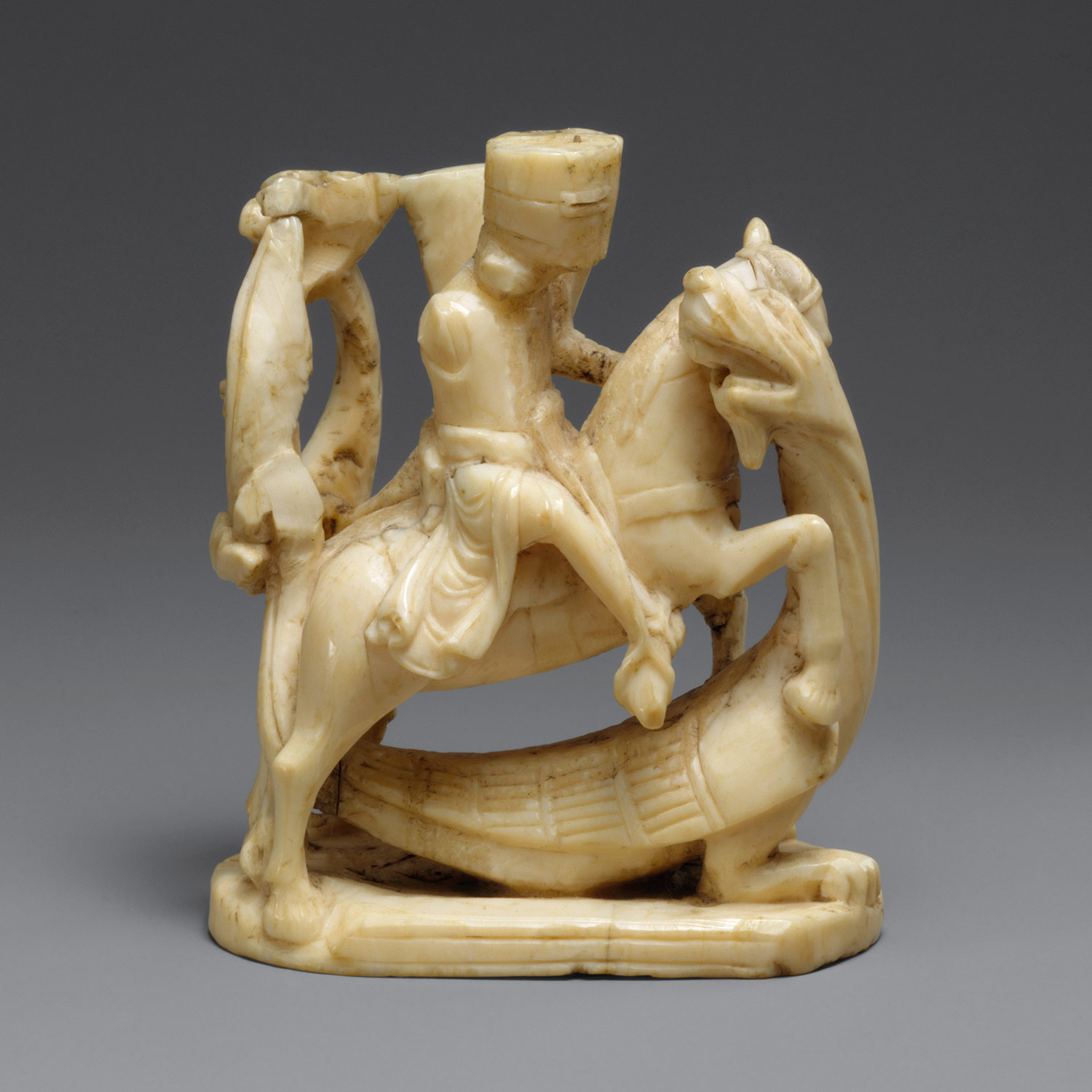
I know, you're probably struggling to figure out which one is the real thing and which one is my personal sketch. It's okay, I'll clear it up for you. The top one is my sketch and the bottom one is the actual artwork. I know, it's really hard to tell.
VISUAL ANALYSIS:
This chess piece was made by Georges Hoentschel, but gifted to J. Pierpont Morgan. The piece was created approximately in 1250, with no specific date to it's name. The piece is 7.8 x 6.5 x 3.5 centimeters. The chess piece has no name, but is recorded as: "Chess Piece in the Form of a Knight."
The knight piece was said to have been created in London, England in 1250 A.D.. That means this piece was created right before the cultural Renaissance movement. This means that the chess piece has no influence by the age of humanism or any type of Greek mythology. That could be inferred, because it chooses to portray a knight with no detailed human features. What I mean by that is the artist, Hoentschel, chooses not to put a face to the Knight. This makes the knight less like a human, because a person's face is one of the most distinguishable features of our species.
As stated before, this work is a chess piece, more specifically, the knight piece. The subject of the piece is the knight fighting a dragon. This is important, because Chess was used as a training mechanism to help knight think up battle strategies. The purpose of the knight fighting the dragon is to remind whoever is playing what a knight stands for and the purpose of this game. They play to figure their best strategies for attack, to take down the enemy at all costs.
For the style of this work, it's arranged in an interesting way. Hoentschel obviously meant for the knight to be the stronger figure in this equation. This can be implied due to the fact that the knight's horse is stepping all over. By structuring the sculpture this way, Hoentschel implies that the knight is the more dominant one in the fight. However, the missing arm reminds the knight playing that sacrifices will be made in battle.
The functional purpose of the piece is to be sturdy so it doesn't break when someone plays chess with it. However, there is a lot of significance to this piece as well. There was a lot about this stated before, but I want to reiterate what I said. This work is a chess piece, more specifically the knight piece. During this time period most soldiers and captains would play chess to help them come up with better battle plans. The overall purpose of this piece is to encourage the knights who were playing that they do have the strength to succeed that their title as a knight embodies something bigger than themselves. It embodies a hero, someone who can slay any beast or enemy, and they have to honor this title given to them.
P.S. HAPPY BIRTHDAY MRS. GENESKEY
Sunday, October 25, 2015
I once made a theatre show on puns. It was a PLAY on words!

I get a nice freebie for this post, because I got to go to the play and here's my snapchat of you at the play to prove it!
p.s. Happy Birthday, Mrs. Genesky!
Monday, October 12, 2015
The dead batteries were give out, FREE of charge!
I'm gonna take this one free, but Happy Birthday Mrs. Genesky!!
Sunday, September 27, 2015
The man put his name on the neck of his shirt so he would have COLLAR ID.
My name, Chloe, is a Greek name. It was a name given to the people from the Greek Goddess of agriculture, Demeter. Chloe means: green shoot, fresh blooming, and famous bearers. However, I know my name a different meaning to it all together. I was named after my mother's favorite perfume brand, Chloé. I think this puts a nice twist to my name. I also like to believe that this helps define me. My mom used to tell me that I am sweet and lovely as her perfume. I like to think that's still true.
I want to say that there is only one me that everyone gets, but that's not the case. My personality involuntarily changes around people dependent on my comfortability level with them. There's a wide spectrum of Chloes ranging from Family Chloe to Strangers Chloe. Family Chloe gets it all, every bad pun, stupid question, and weird obsession. I'm a completely different person with my family than I am around strangers. Stranger Chloe is a little more soft spoken. She's definitely nicer and a little shy. It's all in a bad attempt to make a good first impression.
One situation I can think of when I am apart of a group and am defined by that group is when I'm with my siblings. "The Villazor Kids" becomes this package of 5 people, who all have the same parents, that my mom and dad like to brag about to other parents. I'm no longer just Chloe. I'm the middle child who is following in the foot steps of her older two siblings. It's a little strange, because I lose a sense of self. All of a sudden I'm being compared to my siblings and what they have accomplished and people are asking if I plan on doing the same thing or something different. I have to meet my parents' expectations and more. I have to be Chloe, while at the same time be like my sister or my brother who have already done great things. It's no longer my accomplishments. It's my accomplishments compared to what my siblings have also accomplished, diminishing them just a little bit.
p.s. Happy Birthday Mrs. Genesky!
I want to say that there is only one me that everyone gets, but that's not the case. My personality involuntarily changes around people dependent on my comfortability level with them. There's a wide spectrum of Chloes ranging from Family Chloe to Strangers Chloe. Family Chloe gets it all, every bad pun, stupid question, and weird obsession. I'm a completely different person with my family than I am around strangers. Stranger Chloe is a little more soft spoken. She's definitely nicer and a little shy. It's all in a bad attempt to make a good first impression.
One situation I can think of when I am apart of a group and am defined by that group is when I'm with my siblings. "The Villazor Kids" becomes this package of 5 people, who all have the same parents, that my mom and dad like to brag about to other parents. I'm no longer just Chloe. I'm the middle child who is following in the foot steps of her older two siblings. It's a little strange, because I lose a sense of self. All of a sudden I'm being compared to my siblings and what they have accomplished and people are asking if I plan on doing the same thing or something different. I have to meet my parents' expectations and more. I have to be Chloe, while at the same time be like my sister or my brother who have already done great things. It's no longer my accomplishments. It's my accomplishments compared to what my siblings have also accomplished, diminishing them just a little bit.
p.s. Happy Birthday Mrs. Genesky!
Sunday, September 13, 2015
What Do You Call a Duck Who Likes Watching Fireworks? A FireQUACKER!

This photograph is entitled Fourth of July and it was pictured by photographer, Wing Young Huie. This photo was taken on the 4th of July between the years of 1997-2000 in Powderhorn Park, Minneapolis.
At first glance, the photo is average. It's a black and white photo that depicts the Fourth of July. Friends or family are going out to watch fireworks in order to celebrate The Declaration of Independance. These friends, or family, have decided to watch the fireworks at a close by lake. There are a few trees and lights on the other side of the lake, or other body of water. That's the big picture, the surface statement. However, this picture is much more than that. Much more.
If we were place this picture under a literary microscope, the deeper meaning is revealed. The innocent bystanders are being othered by society. In the typical fourth of July setting, it's crowds of people watching the fireworks, but in this picture there are only three. These three people are being othered for one reason or another by society. They are isolated from everybody else. The reason they are being isolated is ultimately unknown, and up to interpretation. The picture is black and white and the people are only silhouettes. The reason for them being sihouetted is so that the viewer can imagine what they want, it leaves the people up to the interpretation of the viewer. The reason they are being othered can be racial, gendered, religon based or anything that comes to the viewer's imagination. At first glance, I assumed the people were a minority race and were isolated due to racial prejudices in America. I came to that interpretation after viewing other works by Huie.
Wing Young Huie is not the only person who depicts the concept of othering in their respective works. Like Huie, Maragret Atwood others some of her characters in her novel, The Handmaid's Tale. Huie others his characters through visuals and interpretation. The people are othered explicitly, but it's up to the viewer's ideals to say why they are being othered. Atwood explicitly others her characters. The characters othered in The Handmaid's Tale are Unwomen. These are women who are infertile and live in the colonies. These characters are othered, because they cannot fulfill the role a women has in Gilead. They are infertile, cannot beat children in a society that values a women's reproductive system. These characters are isolated due to the fact that an unwomen never appears in the novel. They are all in the colonies and Offred never gets the option of meeting one of them, because if she were to it would humanize the group and would defeat the purpose of othering them.
p.s. Happy Birthday Mrs. Genesky!!
Subscribe to:
Posts (Atom)