Sunday, November 22, 2015

"Is this a BLOG POST which I see before me..."


I like to think everyone is a little evil. Just to make myself feel better about my life choices. However, if someone were to not consider themselves evil, then they're probably going to be the most evil. The first step to achieve this level of evil is temptation. Temptation plays a huge role in converting to the dark side.

Temptation is defined as, a desire to do something, especially something wrong or unwise. This could be seen as anything, however a common form of temptation is, "do not..." The minute someone says you can't do something, it's all of a sudden the only thing you want to do. A great example of this is from popular american sitcom series, How I Met Your Mother. In their episode Lobster Crawl, Robin is told that she can no longer have lobster due to her allergies. Now, Robin has a sudden huge desire to consume Lobster. The temptation was too real.

Temptation is seen with in all throughout Shakespeare's play, Macbeth. It starts in Act 1, scene 3 when the witches first tell Macbeth and Banquo the prophecy. The pair listen to the tantalizing words of the witches, foretelling of the success of themselves and their descendants, "Thou shalt get kings, through though be none: So all hail Macbeth and Banquo!" (Macbeth 1.3). Seeing as this is only a prophecy, that doesn't mean it has to necessarily come true. That's why Banquo makes nothing of it. Macbeth on the other hand is fixated on their words. 

The witches' prophecy is a great example of temptation in Macbeth. As stated before, they told a prophecy, a mere prediction of the future. This doesn't mean that their fortunes are set in stone. However, the idea of a royal crown sparks something within Macbeth. The idea of one day being ruler being a future possibility is very alluring to him. This is what begins his drive on the highway to hell. 

There are many consequences for a person who decides to turn evil. For example, they're no longer good. Along with their, they trade in their sanity and morals for their dark desires. In no way shape or form do the witches tell Macbeth to kill for the throne, he does that on this own accord (with the help of some serious Lady Macbeth-thing). The temptation for the crown and power for caused Macbeth to throw away his moral compass and murder (the now) late King Duncan and his guards (Macbeth 2.3). Later on in the story, Macbeth makes no hesitation in killing his bff Banquo to secure his power (Macbeth 3.3). It's okay, who really needs a moral compass when you can be a tyrant anyways? 

Along with a loss of morals, Macbeth is slowly driven to insanity. After the impulsive murder of his friend, Macbeth sees his ghost appear before him at his house! The estranged ghost of Banquo decides to pop into Macbeth's dinner party (as any good friend would), but the thing is only Macbeth can see him (Macbeth 3.4). If that's not insanity, then I don't know what is. The temptation of power has slowly decayed Macbeth's sanity to the point where he's seeing ghosts. 

Sunday, November 8, 2015

"No, she's a full-on Monet. From far away, it's OK, but up close, it's a big old mess."


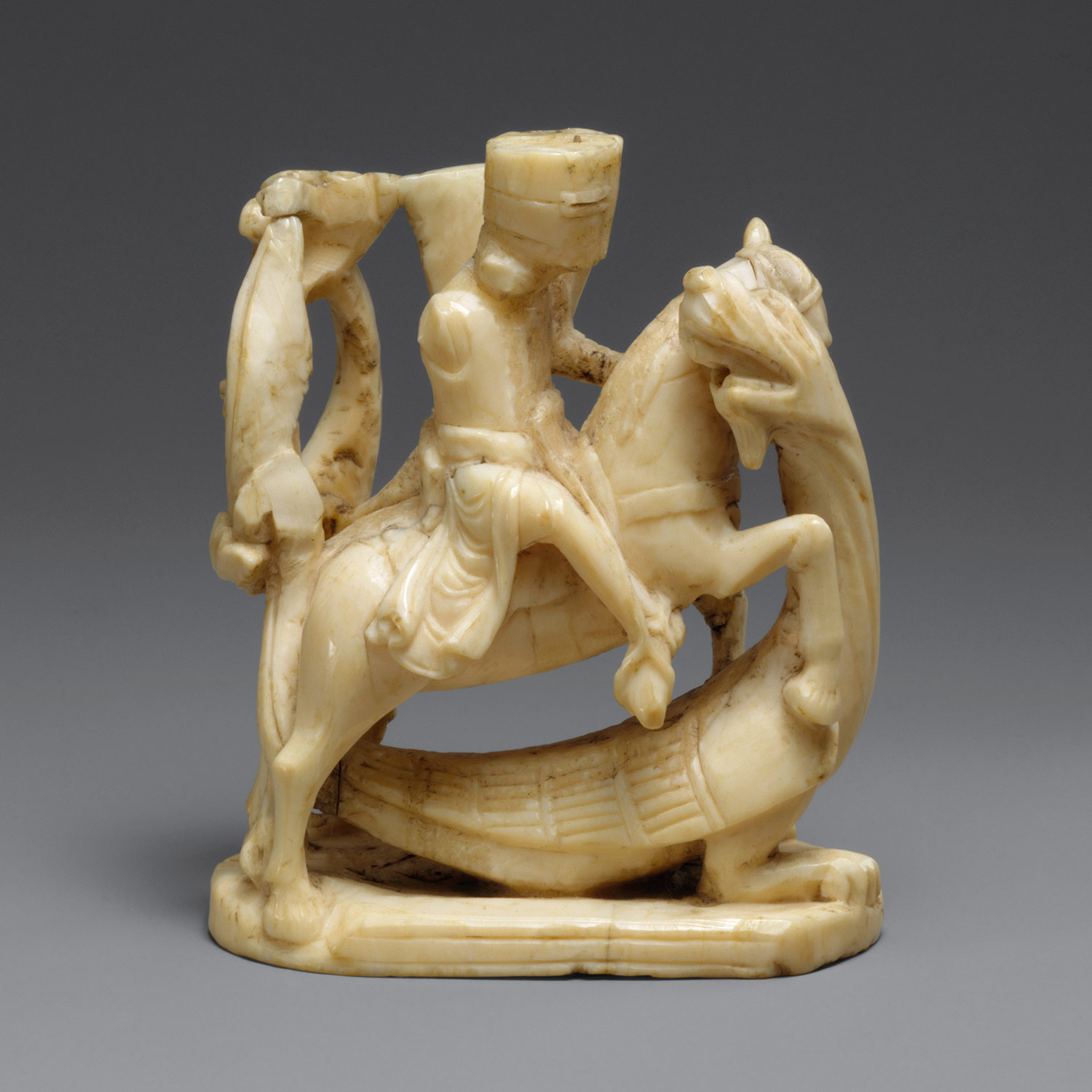
I know, you're probably struggling to figure out which one is the real thing and which one is my personal sketch. It's okay, I'll clear it up for you. The top one is my sketch and the bottom one is the actual artwork. I know, it's really hard to tell. 

VISUAL ANALYSIS:

This chess piece was made by Georges Hoentschel, but gifted to J. Pierpont Morgan. The piece was created approximately in 1250, with no specific date to it's name. The piece is 7.8 x 6.5 x 3.5 centimeters. The chess piece has no name, but is recorded as: "Chess Piece in the Form of a Knight." 
The knight piece was said to have been created in London, England in 1250 A.D.. That means this piece was created right before the cultural Renaissance movement. This means that the chess piece has no influence by the age of humanism or any type of Greek mythology. That could be inferred, because it chooses to portray a knight with no detailed human features. What I mean by that is the artist, Hoentschel, chooses not to put a face to the Knight. This makes the knight less like a human, because a person's face is one of the most distinguishable features of our species. 
As stated before, this work is a chess piece, more specifically, the knight piece. The subject of the piece is the knight fighting a dragon. This is important, because Chess was used as a training mechanism to help knight think up battle strategies. The purpose of the knight fighting the dragon is to remind whoever is playing what a knight stands for and the purpose of this game. They play to figure their best strategies for attack, to take down the enemy at all costs. 
For the style of this work, it's arranged in an interesting way. Hoentschel obviously meant for the knight to be the stronger figure in this equation. This can be implied due to the fact that the knight's horse is stepping all over. By structuring the sculpture this way, Hoentschel implies that the knight is the more dominant one in the fight. However, the missing arm reminds the knight playing that sacrifices will be made in battle. 
The functional purpose of the piece is to be sturdy so it doesn't break when someone plays chess with it. However, there is a lot of significance to this piece as well. There was a lot about this stated before, but I want to reiterate what I said. This work is a chess piece, more specifically the knight piece. During this time period most soldiers and captains would play chess to help them come up with better battle plans. The overall purpose of this piece is to encourage the knights who were playing that they do have the strength to succeed that their title as a knight embodies something bigger than themselves. It embodies a hero, someone who can slay any beast or enemy, and they have to honor this title given to them. 


P.S. HAPPY BIRTHDAY MRS. GENESKEY


Sunday, October 25, 2015

I once made a theatre show on puns. It was a PLAY on words!

I get a nice freebie for this post, because I got to go to the play and here's my snapchat of you at the play to prove it! 
p.s. Happy Birthday, Mrs. Genesky!

Monday, October 12, 2015

Sunday, September 27, 2015

The man put his name on the neck of his shirt so he would have COLLAR ID.

My name, Chloe, is a Greek name. It was a name given to the people from the Greek Goddess of agriculture, Demeter. Chloe means: green shoot, fresh blooming, and famous bearers. However, I know my name a different meaning to it all together. I was named after my mother's favorite perfume brand, Chloé. I think this puts a nice twist to my name. I also like to believe that this helps define me. My mom used to tell me that I am sweet and lovely as her perfume. I like to think that's still true.

I want to say that there is only one me that everyone gets, but that's not the case. My personality involuntarily changes around people dependent on my comfortability level with them. There's a wide spectrum of Chloes ranging from Family Chloe to Strangers Chloe. Family Chloe gets it all, every bad pun, stupid question, and weird obsession. I'm a completely different person with my family than I am around strangers. Stranger Chloe is a little more soft spoken. She's definitely nicer and a little shy. It's all in a bad attempt to make a good first impression. 

One situation I can think of when I am apart of a group and am defined by that group is when I'm with my siblings. "The Villazor Kids" becomes this package of 5 people, who all have the same parents, that my mom and dad like to brag about to other parents. I'm no longer just Chloe. I'm the middle child who is following in the foot steps of her older two siblings. It's a little strange, because I lose a sense of self. All of a sudden I'm being compared to my siblings and what they have accomplished and people are asking if I plan on doing the same thing or something different. I have to meet my parents' expectations and more. I have to be Chloe, while at the same time be like my sister or my brother who have already done great things. It's no longer my accomplishments. It's my accomplishments compared to what my siblings have also accomplished, diminishing them just a little bit. 

p.s. Happy Birthday Mrs. Genesky!

Sunday, September 13, 2015

What Do You Call a Duck Who Likes Watching Fireworks? A FireQUACKER!


This photograph is entitled Fourth of July and it was pictured by photographer, Wing Young Huie. This photo was taken on the 4th of July between the years of 1997-2000 in Powderhorn ParkMinneapolis. 

At first glance, the photo is average. It's a black and white photo that depicts the Fourth of July. Friends or family are going out to watch fireworks in order to celebrate The Declaration of Independance. These friends, or family, have decided to watch the fireworks at a close by lake. There are a few trees and lights on the other side of the lake, or other body of water. That's the big picture, the surface statement. However, this picture is much more than that. Much more. 

If we were place this picture under a literary microscope, the deeper meaning is revealed. The innocent bystanders are being othered by society. In the typical fourth of July setting, it's crowds of people watching the fireworks, but in this picture there are only three. These three people are being othered for one reason or another by society. They are isolated from everybody else. The reason they are being isolated is ultimately unknown, and up to interpretation. The picture is black and white and the people are only silhouettes. The reason for them being sihouetted is so that the viewer can imagine what they want, it leaves the people up to the interpretation of the viewer. The reason they are being othered can be racial, gendered, religon based or anything that comes to the viewer's imagination. At first glance, I assumed the people were a minority race and were isolated due to racial prejudices in America. I came to that interpretation after viewing other works by Huie.

Wing Young Huie is not the only person who depicts the concept of othering in their respective works. Like Huie, Maragret Atwood others some of her characters in her novel, The Handmaid's Tale. Huie others his characters through visuals and interpretation. The people are othered explicitly, but it's up to the viewer's ideals to say why they are being othered. Atwood explicitly others her characters. The characters othered in The Handmaid's Tale are Unwomen. These are women who are infertile and live in the colonies. These characters are othered, because they cannot fulfill the role a women has in Gilead. They are infertile, cannot beat children in a society that values a women's reproductive system. These characters are isolated due to the fact that an unwomen never appears in the novel. They are all in the colonies and Offred never gets the option of meeting one of them, because if she were to it would humanize the group and would defeat the purpose of othering them. 

p.s. Happy Birthday Mrs. Genesky!!